
We had snow in London overnight, and I picked up the dog after a weekend away at his sitter’s. Archie was so happy to see me, he couldn’t contain his excitement, and displayed much of his tail wag, jumping and kissing. Soon he barked to be taken to the park before returning home. The main roads were gritted but some residential ones weren’t, the car slightly skidded at one point, thankfully there were no other moving vehicles, people or dogs nearby at the time. I wouldn’t like to drive long distances in these icy conditions. Freezing days always remind me of a warm bowl of congee, in Cantonese we call it “jook”. Congee is actually porridge made of rice, most Chinese families are familiar with it and the preferred choice is white rice. In Hong Kong, where Cantonese food is the traditional style, congee is commonly served at breakfast. In some more grass root neighbourhoods, there are still eateries that specialise in congee. These shops tend to be family run and they cook vats of plain congee and the patrons pick from a variety of toppings for their personalised concoction. To me this is such a classic way of serving food in Hong Kong, not so much a formula but one can pick what they fancy, mix and match according to their mood. Often a common accompaniment alongside is a plate of filling carbs. Those plates could be fried egg noodles with soy sauce, spring onions and beansprouts or thin rice noodles (vermicelli), or steamed rice pasta roll called “Cheung Fun”, or deep fried delicacies, in particular my favourite is a very crisp and airy fritter shaped like a twinned log. In Cantonese, we call them “Yau char kwai” meaning ghosts in scalding oil, or in Mandarin, Youtiao. Legend told depicting a wicked traitorous couple collaborating with the enemy to the demise of a loyal general.
When I was a child, for a few years, my family lived in a ground floor flat with a backyard. By the backgate, each morning, except Sundays, two women (I think they were sisters) would set up their little stall selling homemade congee and steamed rice pasta rolls. They didn’t have other helpers, maybe just one other person to help them serve and so their menu was short and straightforward. But in the winter time, there were a few seasonal dishes, such as panfried radish cake or sticky glutinous rice studded with fried peanuts, Chinese bacon or sausage, mushrooms and alike. But it is their homely congee that the neighbourhood remembered them by. I used to walk past their stall to the corner for my school bus and if I was early, sometimes I would eat a bowl of their congee. Occasionally on Saturdays, i have also bought a takeaway from them and it was quite common to bring your own container (talk about recycling!). I don’t think they knew my name, but they would call out over the steaming trolley of goodies, “Mui Mui, sic mutt yeah ah?” This translates as, little girl, what would you like (to eat)? They were such kind women, sometimes they gave me a little more Cheung Fun without extra charge. Those, steaming hot, drenched in soy sauce, sweet fermented bean sauce, sesame dressing and more toasted sesame seeds were so delicious. And I had to be extremely careful not to splash anything on my white school uniform!
When I was a toddler, my mother cooked congee and mixed it with steamed white fish and chopped plain cooked green. It was and still is a fantastic meal to introduce solid food to young children. The plain type, made up of just rice, water, and salt remains a popular choice when one doesn’t have much appetite, has eaten too much and need to rebalance (perfect after the festive indulgence!), or is recovering from sickness, as it is gentle and easily digestible. When I make mine, I try to cater for my husband’s taste and keep it simple and pleasing. Sliced boneless chicken, spring onions and ginger or homemade pork meatballs seem to have the most acceptance in my household. Congee is an unassuming and heartwarming dish, without fanfare, and to me it is homely and always made with love and care. When someone makes it for you, you know “you are always on their mind”. So when I see a version with too much adornment or expensive and rare ingredients on my past visits to Hong Kong, sadly they have missed the point.
I always make a good few portions as it keeps in the fridge for up to 3 days. I have not tried freezing them before. To reheat from chilled, my preference is in a saucepan for best results. Microwaving seems to make it lumpy and jammy and it takes many repeats to pause and stir. My recipe makes 4 generous portions, to serve alongside some stir fried vegetables as a main meal.
2 skinless chicken breasts, about 400g
1 bunch of spring onions
100g fresh ginger, or to taste
Seasoning: salt, white sugar (any type), ground white pepper, Chinese Shaoxing wine or Japanese mirin or dry sherry (not cream), light soy sauce, toasted sesame oil, cornstarch, neutral flavour cooking oil (such as vegetable oil, sunflower oil)
3 quarters full of a standard average drinking mugful of white rice, I prefer to make 50% Japanese shortgrain and 50% Thai Jasmine, to give a balance of aroma and soft texture. Don’t use basmati rice as the grains tend to remain whole throughout.
- Mix the rice grains together and put them in a mixing bowl. Pour tap water over them and lightly agitate them briefly. This is just to rinse off the impurities if any. Don’t worry about the murky water, it is the starch on the surface of the grains as they were milled. This starch will give a soft, smooth and creamy consistency to your congee. Drain the grains well and put them into a bowl. Add half a teaspoon of fine salt and a tablespoon of neutral flavour oil, mix well and set aside.
- Rinse the spring onions and peel the ginger. Thinly julienne (this means thin matchsticks) the spring onions and the ginger, set them aside.
- Thinly slice the chicken breasts and put them in a bowl. Add 1 teaspoon of salt, a teaspoon of sugar, a good few shakes of ground white pepper, a teaspoon of toasted sesame oil, 1 teaspoon of light soy sauce, a capful of Shaoxing wine (about a tablespoon) and 2 teaspoons of cornstarch. Stir in one direction to mix well, until all the cornstarch has been incorporated and no dry flour remains. Now in two additions, stir through 2 tablespoons of water. Once again mix in one direction, so the water is absorbed into the chicken. Add the second spoonful after the first has been fully absorbed. Put the bowl into the fridge after this.
- Make the rice porridge. In a spacious* saucepan with a lid, spacious means it will contain 9-10 times of water to the amount of the grains (ratio is 1 part rice : 9 or 10 parts of water) and the prepared chicken. I prefer my congee medium thick, to give it substance. Pour over the cold water (from the tap) into the pan, lid on and turn on the heat to bring it to temperature. When you can see little bubbles forming at the bottom of the pan, add the marinated rice grains. Stir and bring it all to the boil. After that, turn it down to low heat to simmer for 40 minutes. Stir it from time to time so the grains don’t catch at the bottom of the pan. You may also need to keep the lid ajar as it can bubble over, even on low heat.
- When the time is up or the porridge has reached your preferred consistency, add the chicken pieces. Use a pair of chopsticks to separate the pieces so they are not in a big ball. Keep the heat to medium low to poach and cook the chicken, this will help them to remain silky and soft. When the chicken is nearly cooked, all evenly opaque, not jelly like, add most of the ginger and spring onions, reserve some to garnish at the end. Stir through for a minute to cook through. Check the chicken is cooked, take a piece out and check if in doubt. Taste and adjust seasoning with salt and ground white pepper.
- Get the bowls ready and ladle over, garnish with the remaining ginger and spring onion before serving. If you like simple toppings to add crunch, fried peanuts, fried onions (sold in tubs), or even Bombay Mix are easy to find. Traditional cooks used to fry some spring roll wrappers and scrunch them over (my childhood favourite).
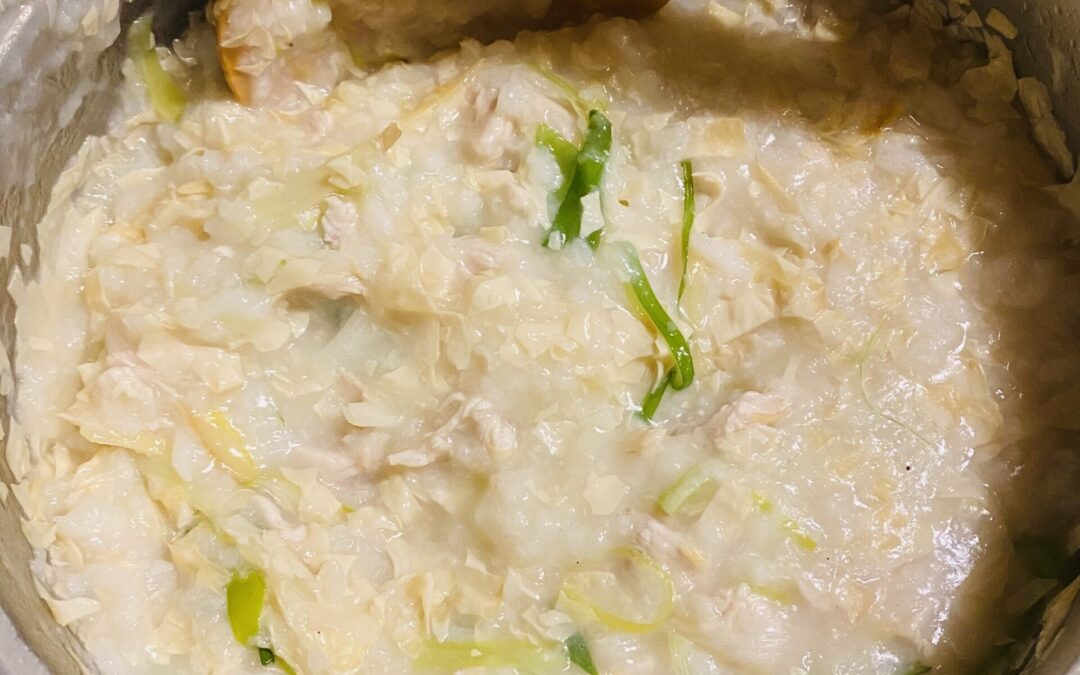
PS just that you know the congee does thicken the longer it cooks and as it cools (see photo). Add a little water to let it down, especially when reheating and adjust seasoning if required.
I so enjoyed writing this post to give you a glimpse of homely Cantonese comfort food. I have visited a few rare places in London Chinatown that serve it, unfortunately none does it for me. They were too salty (with added MSG), not much substance, and gave a very mean serving of proteins….but a big price tag. Congee isn’t very commonly served to guests, and if you do make it, please let me know what you think. Drop me a line via Contact Me.
Recent Comments