
Cakes seem a common language across all cultures. I grew up eating western style cakes at celebrations, or “just because it is teatime” in Hong Kong. In those days, we didn’t have many fancy patisseries but what was available at the time was affordable to most. Nowadays, the artisan cafe culture is thriving with many offering beautiful patisserie with Japanese and French influences that showcase a lot of intricate pastry skills. Their craft can compete on the world stage. When I was growing up, Hong Kong was booming with investments and entrepreneurs, both homegrown and foreign and the productivity was impressive. Many local bakeries offered fusion style cakes, buns and cookies. Fusion in the sense that it was unique to the taste in Hong Kong and the case in point is that, it is not too sweet. To many locals, a good dessert (western or Chinese style alike) should not be too sweet. Very seldom one would find thick icing on their baked goods, there could be a glaze or a few nibbed sugar on buns, but these tend to be a selected few.
The baked goods in my childhood weren’t substantial. Hefty ones like fruit cake, banana cake, ginger loaf, and alike were unfamiliar, instead locals preferred (and still do) the lighter texture cakes with classic flavours, such as vanilla, coffee, apricot, coconut and chocolate, and latterly, Matcha (Japanese green tea). These cakes were sold in two forms, ready cut pieces or whole cakes. For a celebration, a gateaux filled with fresh cream and fruit continues to be a popular focal point to this day. Tropical fruits like fresh sweet mangoes are on year round display, they glisten under the lighting so invitingly. I used to ask for it for my birthday. Other popular bakes are the rich Black forest gateaux (but not much booze in it) and chiffon cake, layered with chestnut cream or “marron glace cake”. A variation of the chestnut one in the form of “Mont Blanc” on a shortcrust pastry base can still be found nowadays. In the last 20 years or so many options, from the colourful French macaron to Gateaux Opera have popped up all over town. Hong Kong folks love new creations, yesterday’s hype is already too outdated and I’m having a hard time keeping up whenever I visit. It is not at all unusual to find your favourite longstanding independent shop disappears and replaced by a new invention or import.
Both then and now, when one gets married, to share the joy it is customary to send cake cards to friends and family with the wedding invitations and these cake cards are usually paid by the bride’s family! You won’t find a printed monetary value on these gift cards, but one would exchange for a dozen pieces of cut cakes or two cards for a gateaux. My mother used to take me and my sister to the shop and we would excitedly make our selection. “What do we pick from the glass cabinets?”, cried the two of us and out came the fingers counting, making sure all our favourites were picked and if we both liked the same piece, we got two of those. My younger sister loved anything with chocolate, and she would pick at least one piece of the triangular one, coated with a thin glaze. It was a chocolate sponge cake, cut into strips with thin layers of buttercream in between, and dipped in a chocolate coating. I liked the Swiss roll, and the original vanilla flavour, plain and simple. You can still find these types of cakes in London Chinatown. After i have lost the Christmas weight (!), I will make a visit and write about a purchase.
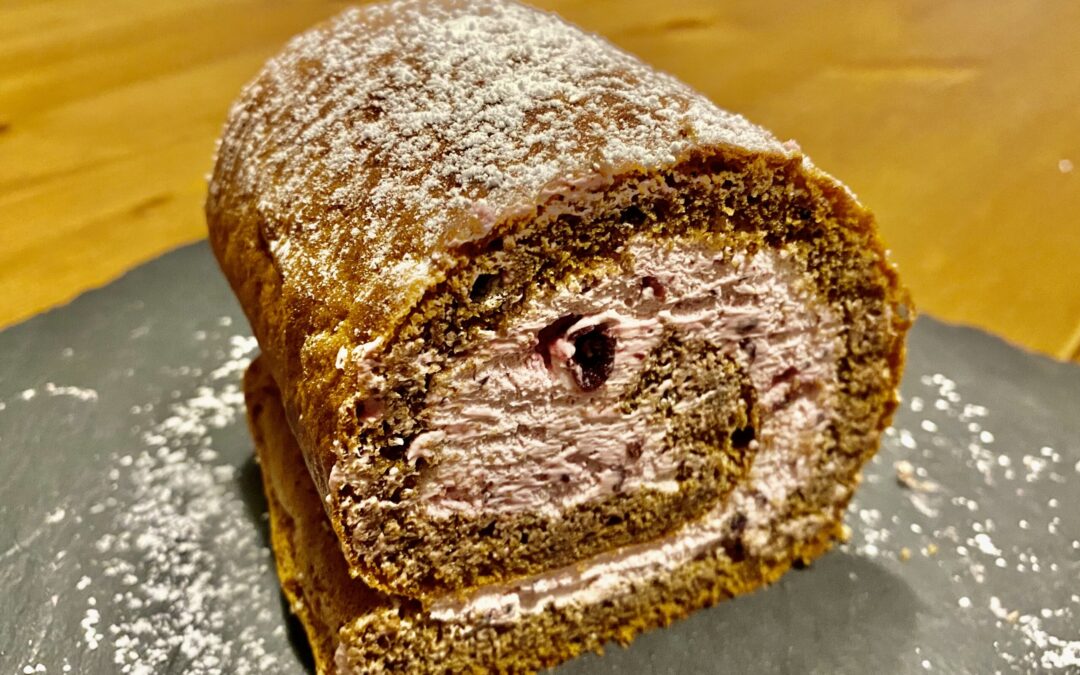
My coffee Swiss roll with blackcurrant cream is a bit unusual in the flavour combination, but it does work! This recipe serves 6.
60g self raising flour
40g instant espresso powder (I used Percol)
70g caster sugar and 2 tablespoons more for the cream
3 medium eggs
200ml double cream
150g blackcurrant jam (I used St Dalfour)
– Heat the oven to 220C/200C fan/gas 7. Line a 22 x 32cm swiss roll tin (if it’s 20 x 30cm that’s still fine) with baking parchment*, don’t forget the sides and corners. Sift the flour and espresso powder onto a piece of parchment, do this twice. Sifting removes any lumps and will aerate the grains to make it lighter. Set aside for now.
– Crack the eggs into a mixing bowl and tip in the sugar. Use an electric whisk, beat the eggs and sugar together for 5-7 mins until pale (almost white) and very thick (you can test this by stopping the whisk and lift it up. The mixture should leave a trail before disappearing. This is called the ribbon stage). Now add the sifted flour and espresso mixture into the mixture. Use a spatula or a large metal spoon to gently fold in the flour mixture until completely incorporated and everything’s the same colour with no streaks or dry flour in the mixture. Do this gently to retain the air from the whisking (so it remains light) and also not to develop the gluten in the flour, as this will make the sponge tough.
– Gently scrape the mix into the tin and spread to the corners. Bake for 9-10 mins until puffed up and springy to touch. Don’t overcook this as the sponge will dry out also it will crack if it is over baked, remembering there is no added fat in the mixture. While the cake is baking, get another piece of parchment a little larger than the tin. When the sponge is cooked, let it cool for a few minutes (just enough to handle), wear oven gloves to carefully invert it onto the paper. Now the top of the cake is facing down. Lift off the tin and peel away the top layer of parchment carefully so you don’t tear the sponge. Now turn the sponge (keep it facing down) on the paper so it looks like a A4 portrait. Score a line 2cm from one of the shorter edges (I do it on the edge closest to me), then use the parchment to roll the sponge away from me, into a spiral with the parchment running through it, tucking it in as you go along. Keep the seam at the bottom. Leave the rolled sponge to cool completely in the parchment. If you do the rolling while the sponge is still warm, it should remain pliable.
– While the cake is cooling in the parchment, make the filling by whisking the cream and 2 tablespoons of sugar, just enough that it holds its shape. This means when you stop the whisk, you see a soft wave in the cream, it should neither be sloppy or too firm. Unroll the sponge and spread the jam on one layer all over the surface that is facing you, then repeat with a layer of the whipped cream. Now starting from the scored edge, use the parchment to roll the sponge up around the filling. This time make sure you do not keep the parchment inside! Lift onto a board or serving platter and dust with icing sugar, if liked. The finished Swiss roll can be served straight away or chilled for up to 24 hrs.
*Baking parchment/paper is siliconised on both sides of the paper, which stops food from sticking, it is perfect for baking. Even when you invert the cooked sponge onto it, it does not stick and does not require any dusting of sugar at this stage. This paper feels a bit “waxy”. Greaseproof paper on the other hand, is not siliconised and does not prevent sticking. This paper is good for food packaging, like wrapping sandwiches. Please don’t mistake the two as the sponge will stick to the greaseproof paper.
Swiss roll is a bit retro, fresh ones are almost unheard of in the shops, not even at afternoon teas; the only kind I can find seems to be the long dated factory made stuff in the supermarket. They have their place obviously, such as using it as a base for the quintessentially British trifle. Give my recipe a try. It really is simple and quick to make. If you don’t like coffee, substitute it with good quality cocoa powder (not hot chocolate mix, that’s full of sugar, milk powder and cornstarch), and add some vanilla extract and a tablespoon of sugar to the cream when whisking.
Recent Comments